Scaling AI Models in Production: What the Benchmark Numbers Do Not Tell You
Scaling AI models in production requires more than a strong benchmark score. Here is the complete guide covering the five root causes of scaling failure, quality degradation patterns, and the six production readiness checkpoints.
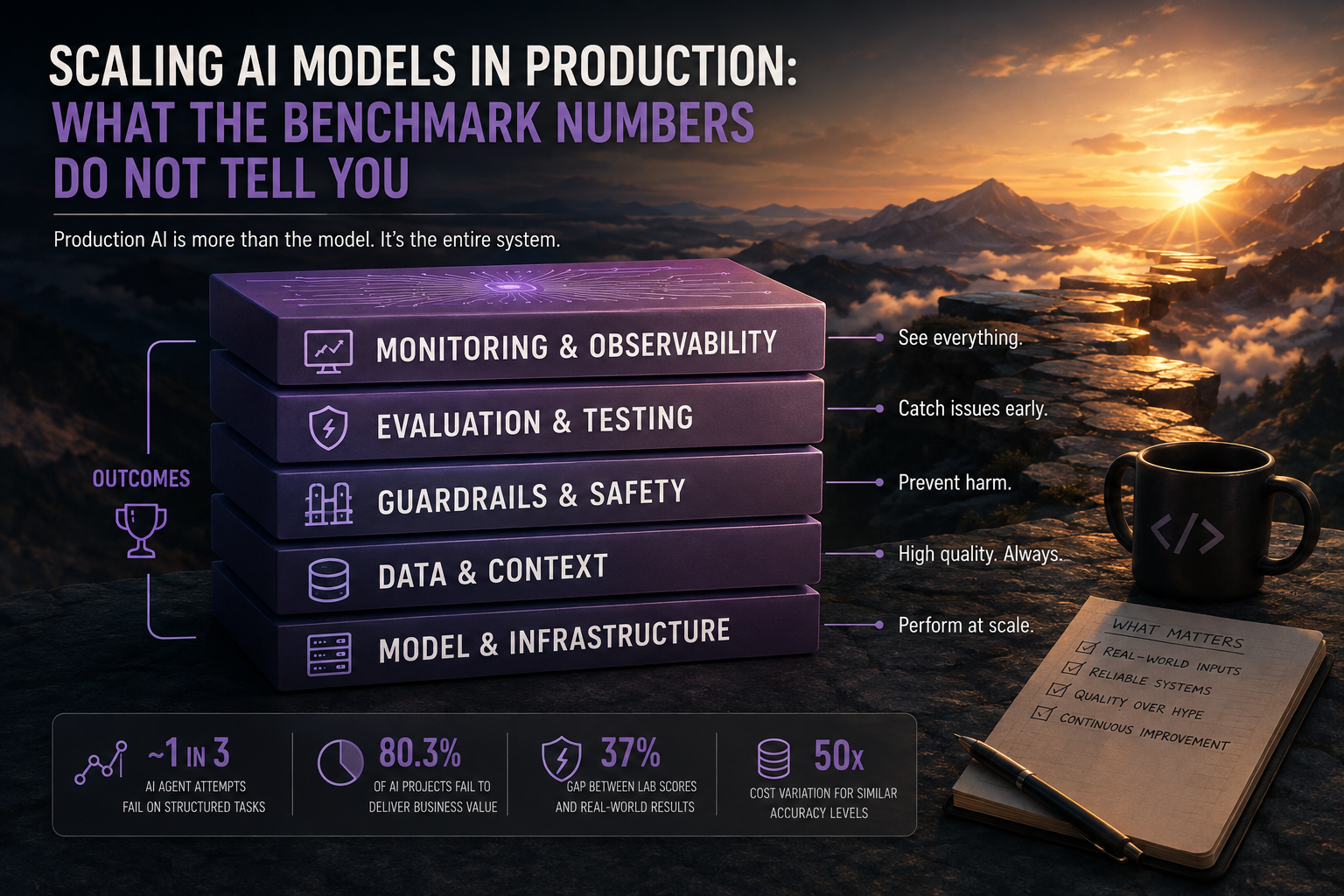
A model that scores 94 percent on a capability benchmark and fails one in three production attempts is not a contradiction. It is the defining operational reality of enterprise AI in 2026, and it is the gap that benchmark numbers are structurally incapable of closing.
The Stanford HAI 2026 AI Index documents what engineering teams working in production already know: AI agents embedded in real enterprise workflows are still failing roughly one in three attempts on structured tasks. MMLU and similar benchmarks are functionally saturated at the frontier, with top model scores above 88 percent making statistical differences between models meaningless for production decision-making. An independent evaluation covering enterprise agentic AI systems found a 37 percent gap between lab benchmark scores and real-world deployment performance, with 50 times cost variation for similar accuracy levels across different deployment configurations.
The numbers that matter are not on the benchmark leaderboards. They are in the incident logs, the cost dashboards, the quality monitoring reports, and the organizational postmortems of the 86 percent of enterprises that have AI pilots running but have not successfully scaled to production.
RAND Corporation research published in 2025 found that 80.3 percent of enterprise AI projects fail to deliver promised business value. Of that figure, 33.8 percent are abandoned before reaching production, 28.4 percent reach production but fail to deliver expected value, and 18.1 percent run but never recover their investment. Only 19.7 percent deliver on their business case. Gartner's April 2026 survey of 782 infrastructure and operations leaders confirmed the pattern: only 28 percent of AI use cases fully succeed and meet ROI expectations.
This article covers the specific mechanisms that produce those numbers, the five root causes that account for 89 percent of production scaling failures, the quality degradation patterns that benchmark testing does not surface, and the operational infrastructure that separates the organizations delivering on their AI investment from the ones still explaining why the pilot did not convert.
Marka's engineering team works with enterprises across healthcare, manufacturing, finance, and public administration on AI system architecture and production delivery. If your organization has AI in development that is not reaching production scale, the architecture and governance review is the right starting point. Reach the team at marka-development.com/contacts.
Why Benchmarks Fail to Predict Production Performance
Benchmarks measure what models can do under ideal conditions. Production measures what models actually do under real conditions. The gap between those two measurements is not a rounding error. It is a structural difference in what is being evaluated.
Benchmark evaluations use clean, curated datasets where inputs are well-formed, edge cases are excluded by design, and the evaluation criteria are known before the test runs. Production inputs are messy, ambiguous, inconsistently formatted, and frequently outside the distribution the model was evaluated against. A model that scores 95 percent on a curated benchmark may score 70 percent on the real inputs your users actually generate, and there is no benchmark that tells you that before you deploy.
The jagged frontier, a term coined by AI researcher Ethan Mollick and documented extensively in the Stanford HAI 2026 report, describes the specific quality of this performance gap. AI models can win a gold medal at the International Mathematical Olympiad but still cannot reliably tell time. They perform at expert level on specific task types and fail unpredictably on adjacent tasks that appear simpler. The boundary between competence and failure is not a smooth curve. It is jagged, domain-specific, and impossible to predict from benchmark scores alone.
Data contamination compounds the problem. Benchmark datasets are increasingly present in model training data, which means high scores may reflect memorization rather than genuine capability. Annotation error rates above 50 percent have been documented in widely cited benchmarks, meaning the ground truth the benchmark uses to score models is itself unreliable. The score means less than it appears to.
The practical consequence for engineering teams is that no benchmark score replaces production evaluation on your specific use case with your specific data. A model selection decision made primarily on benchmark performance will produce the wrong architecture for a significant fraction of enterprise use cases. The only evaluation that matters is an evaluation against the inputs, edge cases, and quality criteria that your production system will actually encounter.
The Five Root Causes of Production Scaling Failure
A March 2026 survey of 650 enterprise technology leaders identified five root causes that account for 89 percent of scaling failures. They are interrelated in specific ways, and understanding the relationships between them is as important as understanding each one individually.
Integration complexity with legacy systems. The most technically capable AI model is only as useful as the systems it can access and act on. Enterprise AI deployments that cannot reliably read from and write to the legacy systems that hold operational data and business logic cannot deliver the end-to-end workflow automation that makes AI valuable at scale. Integration gaps that were manageable in a pilot with controlled data become blocking failures in production where the AI needs to access ten systems, not one. This root cause is the one that most directly reflects the architectural gap between a compelling demo and a production deployment.
Inconsistent output quality at volume. A pilot processes 100 test queries with 95 percent accuracy. Production handles 10,000 weekly with real-world edge cases. A 3 percent failure rate, which produces 6 failures in a pilot, produces 300 failures weekly at production scale. Those failures do not average out. They erode user confidence, generate support load, and produce the business value shortfall that makes leaders question whether the AI investment is working. Quality that looks acceptable at pilot volume is often unacceptable at production volume, and the benchmark score does not tell you where the failure boundary is.
Absence of monitoring tooling. Organizations that try to operate production AI on infrastructure built for deterministic software consistently face quality, reliability, and governance failures that are expensive to diagnose and slow to fix. Deterministic software either works or it does not. AI systems produce outputs on a quality distribution that shifts over time, degrades with input drift, and fails in ways that are not always visible without purpose-built monitoring. An AI system with no monitoring is not a production system. It is an experiment running in production, and the difference shows up in incident frequency and mean time to detection.
Unclear organizational ownership. Ownership gaps leave monitoring gaps unfilled, which makes quality problems invisible until they compound into incidents. The question of who owns an AI system in production is not a soft organizational question. It is a hard operational requirement. Someone must own the quality metrics, the retraining decision, the incident response, the cost envelope, and the compliance evidence. When that ownership is unclear, each of those responsibilities is deferred until a failure makes them urgent, at which point the cost of addressing them is significantly higher than it would have been with defined ownership from the start.
Insufficient domain training data. General-purpose models trained on broad internet data perform well on general tasks and poorly on domain-specific tasks that require specialized knowledge, terminology, or reasoning patterns. Healthcare AI that cannot correctly interpret clinical documentation, financial AI that misunderstands regulatory language, manufacturing AI that cannot parse equipment specifications: these are not model failures. They are data failures. The model was evaluated on data that looked like the domain but was not the domain, and the benchmark score reflected the evaluation data rather than the production reality.
The Quality Degradation Patterns Benchmark Testing Does Not Surface
Beyond the five root causes, specific technical mechanisms produce quality degradation in production that no benchmark evaluation is designed to detect.
Model drift. The model that performed well at deployment will drift from production reality over time without ongoing investment to maintain the gap. User language evolves, business processes change, and the world the model was trained on diverges from the world it is operating in. A customer service model trained on support tickets from 2024 will gradually produce lower-quality responses to tickets that reflect 2026 product changes, policy updates, and customer vocabulary shifts. Drift does not announce itself. It accumulates silently until the quality degradation becomes visible in user behavior or output audits.
Version drift from provider updates. Models that look stable in benchmark tests may show behavior changes when a provider updates or retunes a model version, resulting in breaking changes in output format, reasoning style, or tool-call ordering. A workflow that has previously given consistent outputs can suddenly degrade without any change in the application code. This failure mode is specific to organizations using model APIs from cloud providers, where model updates are outside the engineering team's control. Production AI systems need version pinning, change notification processes, and regression test suites that run against every provider update before it reaches production traffic.
Prompt sensitivity at scale. Benchmark evaluations use fixed prompts in controlled conditions. Production prompts vary with user input, context length, conversational history, and the specific state of the system at the moment of inference. A model that performs reliably with the evaluation prompt may perform inconsistently when that prompt is modified by real user inputs at the edges of its context window. Prompt sensitivity is not visible in benchmark scores. It is only visible in production monitoring of output quality across the distribution of real inputs.
Cost degradation under load. LLM inference costs at scale are frequently multiples of pilot estimates. A cost model built on pilot-scale inference volumes and average prompt lengths will underestimate production costs significantly when real users generate longer context, more complex queries, and higher volumes than the pilot represented. This cost degradation is not a quality problem in the output sense, but it is a reliability problem in the business sense: AI systems that cost more than their value disappear from production regardless of their technical quality.
Cascading failures in multi-agent systems. In single-model deployments, a model failure produces a degraded output. In multi-agent systems, a model failure at one step in the pipeline can cascade through downstream agents, amplifying the failure rather than containing it. A research agent that produces a hallucinated fact feeds that fact to a drafting agent, which incorporates it into a document that a review agent then approves because it lacks the domain knowledge to identify the error. The benchmark for each individual model in that pipeline may be excellent. The system-level reliability of the pipeline is a different measurement entirely, and it is one that no individual model benchmark addresses.
The Operational Infrastructure That Production AI Requires
The organizations that deliver on their AI investment share a common structural characteristic: they treat AI production infrastructure as a distinct engineering problem from AI model selection. The model is the smallest part of what makes production AI work reliably at scale.
Evaluation infrastructure built on production data. The only evaluation that predicts production performance is an evaluation run against production-representative data with production-representative edge cases and production-quality criteria. Building this infrastructure before deployment, not after the first quality incident, is the organizational behavior that separates BCG's future-built companies, which report deployment success rates exceeding 60 percent, from the laggards, which report success rates around 12 percent. The evaluation infrastructure includes labeled test sets built from real production inputs, automated evaluation runs against every model update, and human expert review for the edge cases where automated evaluation is insufficient.
LLMOps monitoring stack. Production AI requires monitoring that deterministic software monitoring was not designed to provide. Input distribution monitoring detects when the inputs the model is receiving have shifted away from the distribution it was evaluated against. Output quality monitoring tracks the quality metrics that matter for your specific use case: accuracy, relevance, factual grounding, format compliance, and the domain-specific quality criteria that generic benchmarks do not measure. Cost monitoring tracks inference cost per output at the granularity needed to detect cost degradation before it becomes a budget problem. Alert thresholds on all of these metrics, connected to an on-call ownership structure that responds to alerts, complete the operational picture.
Rollback procedures tested before they are needed. AI systems in production need rollback capability that is tested before it is needed, not drafted during an incident. When a model update degrades quality or a provider change breaks a workflow, the time to restore service is determined by whether the rollback procedure exists and has been tested. Organizations that have never run a rollback drill discover during their first incident that their rollback procedure has gaps that take hours to resolve. The drill takes two hours. The undiscovered gaps take eight.
Human-in-the-loop gates for high-stakes outputs. For AI outputs that carry significant business, legal, or patient consequences, human review gates before the output reaches the end user or triggers a downstream action are both a quality control mechanism and a compliance requirement under frameworks like the EU AI Act's Article 14 human oversight provisions. The gate design needs to specify which output categories require human review, what the review criteria are, how review decisions are logged for audit purposes, and what the escalation path is when reviewers disagree. These are engineering requirements, not process suggestions.
Clear ownership and accountability structures. The Google Cloud DORA 2025 report found that 70 percent of AI transformation value comes from people, organizations, and processes, not from the technology. Deloitte's 2026 State of AI survey found that only 37 percent of organizations have invested significantly in change management alongside AI deployments. The ownership structure for a production AI system needs to specify who owns the quality metrics, who approves the retraining decision, who owns the cost envelope, who is on call for quality incidents, and who is responsible for compliance evidence. Without those assignments, the operational infrastructure does not function regardless of its technical quality.
How to Assess Your Production Readiness Before Deployment
The production readiness assessment that prevents the most expensive post-deployment discoveries runs through six checkpoints before a system moves from pilot to production.
Does the evaluation dataset reflect production reality? If the evaluation data was curated for the pilot rather than sampled from the production input distribution, the evaluation score does not predict production performance. Rebuilding the evaluation dataset from real production inputs, including the edge cases and malformed inputs that real users generate, is the first checkpoint.
Is there a monitoring stack in place before the first production query? Quality degradation that is not detected is not managed. The monitoring infrastructure needs to be operational before production traffic begins, not assembled in response to the first incident.
Has cost been modeled at production volume with production prompt length distributions? The pilot cost model almost always underestimates production costs. Modeling inference cost at production query volume, with the context lengths that real users generate and the retry rates that real error patterns produce, determines whether the system is economically viable before it is deployed.
Are rollback procedures documented and tested? A rollback procedure that exists only in documentation has unknown gaps. A tested rollback procedure has known gaps that have been resolved. The difference is the gap between an eight-hour incident and a thirty-minute incident.
Is organizational ownership defined for every operational responsibility? The owner of the quality metrics, the retraining decision, the cost envelope, the on-call rotation, and the compliance evidence needs to be a named individual or team before production deployment, not assigned after the first incident reveals that nobody owns the problem.
For regulated industry deployments under NIS2, DORA, or the EU AI Act, does the system have the audit logging, human oversight mechanisms, and incident reporting procedures that the applicable framework requires? Discovering a compliance gap after production deployment is significantly more expensive than addressing it during the design phase.
What the Organizations That Get This Right Actually Do Differently
The 19.7 percent of enterprises that deliver on their AI investment do not have better models than the organizations that fail. They have better operational discipline around the same models. The pattern is consistent across BCG's research, the RAND findings, and the Stanford HAI documentation.
They evaluate on production data before deployment. They build monitoring infrastructure as a prerequisite to production launch, not as a response to a production incident. They model costs at production volume before committing to infrastructure decisions. They define ownership before deployment, not after. And they treat the distance between a pilot score and a production metric as an engineering problem that requires an engineering solution, not a communications problem that requires better stakeholder expectation management.
Marka's Cloud and Platform Modernization practice builds production AI infrastructure for enterprise clients across the industries where quality, reliability, and regulatory compliance requirements are most demanding. The production readiness assessment covers evaluation infrastructure, monitoring stack design, cost modeling, rollback procedures, ownership definition, and compliance architecture, as a structured engagement before the first production deployment rather than a postmortem after the first production failure.