How to Build an MVP That Actually Validates Your Idea
Most MVPs fail because teams build too much or cut too deep. Here is the seven-step framework that produces a clean market signal rather than a confusing one for startup founders.
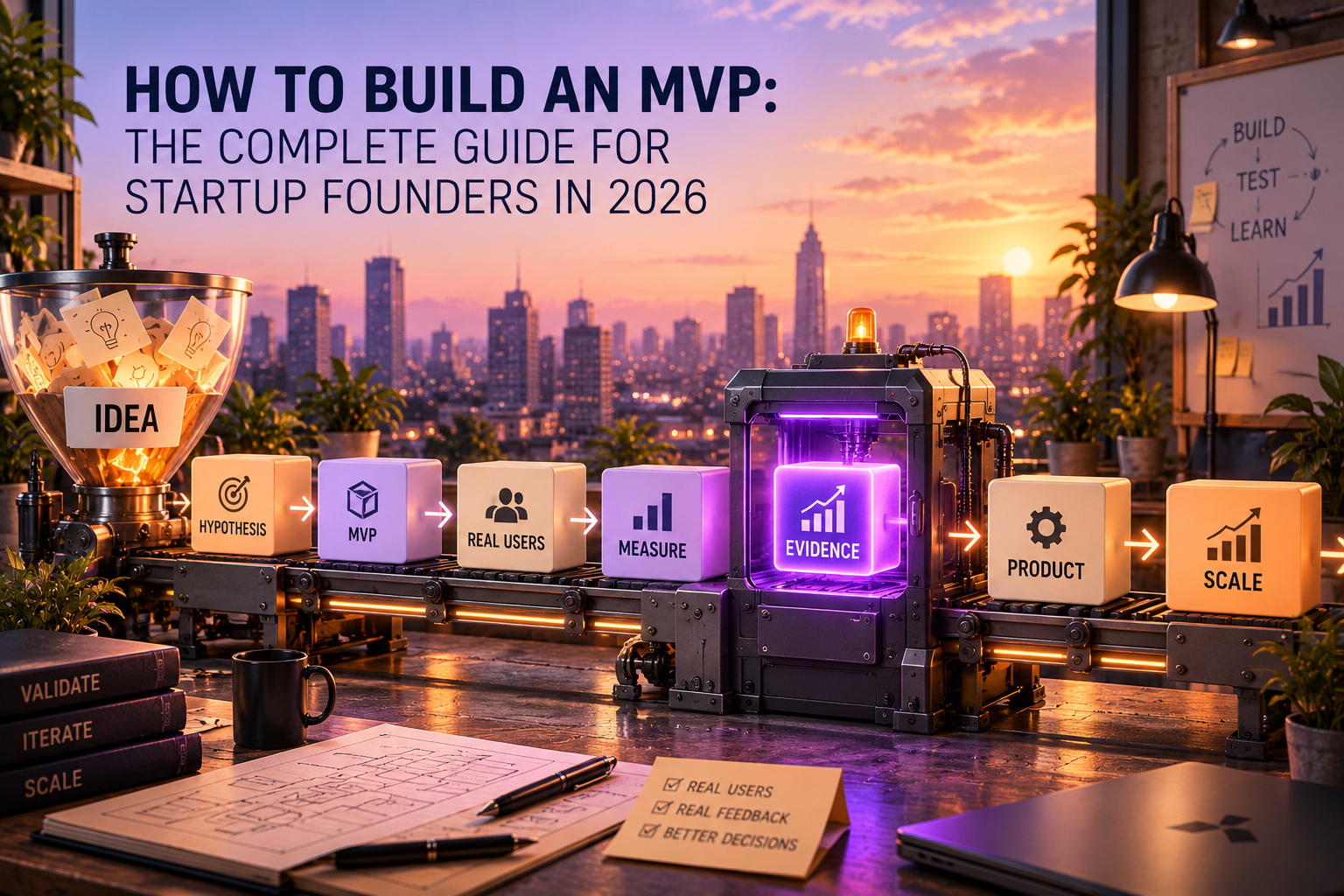
43 percent of startups fail because they build something nobody wants. Not because the code was bad, not because the team was underqualified, and not because they ran out of money first. They ran out of money because they spent it building the wrong thing. The money running out was the consequence. Building without validating was the cause.
The minimum viable product exists to break that chain before it completes. It is the fastest, cheapest path to the answer that determines whether everything else is worth doing: do real people, in real conditions, with real alternatives available, choose your solution over doing nothing?
That question sounds simple. Getting a clean answer to it is not. Most teams either ship something so minimal it cannot demonstrate actual value, or spend months perfecting features no user asked for and call the result an MVP because they shipped it before they were done. Both patterns produce the same outcome: a launch that teaches you nothing useful.
This guide covers what an MVP actually is, the seven steps that produce a clean market signal rather than a confusing one, the measurement framework that tells you whether you have found product-market fit, the AI toolkit that has changed what is possible in the time and budget available in 2026, and the mistakes that most teams make after the first version ships.
Marka has been delivering software for enterprises and growth-stage companies across healthcare, manufacturing, finance, and public administration since 1993. If you are at the idea or early-build stage and want to scope the fastest path to a testable product, the conversation starts at marka-development.com/contacts.
What an MVP Actually Is
A minimum viable product is the simplest version of your product that lets you test whether a real market exists for your idea. It goes in front of actual users, collects actual data, and answers a specific business hypothesis. Not a prototype, which tests design. Not a proof of concept, which tests technical feasibility. Not a beta, which tests stability at scale. A market-facing experiment that answers whether the core value proposition is real.
The confusion between these concepts is not semantic. It produces wrong decisions. A team that builds a prototype and calls it an MVP has not validated market demand. A team that builds a proof of concept and calls it an MVP has not tested whether users will choose the product. A team that builds a beta and calls it an MVP has moved past the moment when pivoting is cheap.
Harvard Business School's Rock Center framing is precise: an MVP is a process of investing the smallest effort to learn, not a product with the fewest features. The minimum is about learning efficiency, not output minimalism. The question is not "what is the least we can ship" but "what is the fastest way to know if we should keep building."
This distinction matters most when defining scope. A feature-sparse product that delivers its core value proposition flawlessly is a well-designed MVP. A feature-sparse product that fails to demonstrate any meaningful value because the team cut too deep is not an MVP. It is an incomplete product that teaches you that it is incomplete, which is not useful learning.
Startups that begin with a properly scoped MVP are 70 percent more likely to succeed than those that launch with fully-featured products without prior validation, according to Startup Genome 2024 data. The MVP approach delivers a 60 percent higher success rate than launching with a full product by compressing the timeline between hypothesis and evidence.
Step 1: Define the Specific Problem and the Specific Person Who Has It
Every successful MVP begins with a problem statement specific enough to generate testable predictions. Generic problem statements produce generic products that nobody finds essential.
The difference between "people waste time on invoicing" and "freelance designers billing under 10 clients lose approximately 4 hours per week recreating invoice templates in spreadsheets" is the difference between a product category and a product. The second statement tells you who to talk to, what to observe, what the baseline behavior is, and what success looks like. The first tells you almost nothing actionable.
Talk to 15 to 20 people who match your target profile before writing a line of code or a product specification. Not to validate your idea, but to understand whether the problem you think exists is the problem they actually experience. The language people use to describe their own problem is the most valuable input to your product definition, your positioning, and your go-to-market message. You cannot replicate it by reasoning about the problem from the outside.
The questions that produce useful answers are not "would you use a product that does X." They are "walk me through the last time you experienced this problem," "what did you do about it," "why did that not fully solve it," and "what would you have paid for a complete solution." Behavioral and economic data from real conversations is more predictive than stated preferences from hypothetical scenarios.
Step 2: Identify and Test Your Riskiest Assumption
Every product idea rests on a stack of assumptions. Some of those assumptions, if wrong, mean the product cannot work regardless of execution quality. Those are your riskiest assumptions, and they are the ones your MVP needs to test first.
A marketplace product assumes that supply and demand can be aggregated at sustainable unit economics. A SaaS product assumes the problem is painful enough that people will pay to solve it rather than tolerate it. A consumer app assumes users will change an existing behavior to adopt a new one. Each of these assumptions can be tested cheaply before a full product is built, and if the test fails, the information is valuable and the cost is low.
The minimum experiment to test your riskiest assumption is not always a software product. Dropbox's famous demo video tested the core assumption that people wanted effortless file sync before the sync infrastructure existed. Buffer tested willingness to pay for social scheduling with a two-page website and a Stripe integration that collected payment for a product that did not yet exist. Zappos tested whether people would buy shoes online by manually fulfilling orders from a local store before building inventory or logistics. In each case, the test was designed around the specific assumption that, if wrong, would invalidate the entire business model.
The mistake most teams make is testing the assumptions they are confident about rather than the ones they are uncertain about. The MVP scope should be determined by the riskiest assumption, not by the features the team most wants to build.
Step 3: Define a Value Proposition That Fits One Sentence
If you cannot describe your product's value proposition in one sentence that a ten-year-old could understand, your MVP scope is too broad.
The sentence structure that works: for [specific user], who [has this specific problem], our product [solves it this specific way], unlike [current alternative]. Every word in that sentence is a scope constraint. If you cannot complete it without using "and," you have two products.
This is not a marketing exercise. It is a product definition exercise. The value proposition sentence is the test that every feature in your MVP must pass: does this feature directly deliver the value described in the sentence? If not, it belongs in version two.
The teams that ship MVPs that fail to produce clean market signals are almost always teams whose value proposition was too broad at the time they built. The learning from a broad MVP is "users had mixed responses," which does not tell you what to do next. The learning from a focused MVP is "users who match [specific profile] found the core value proposition compelling" or "they did not," which tells you exactly what to do next.
Step 4: Map the Minimum User Journey and Apply MoSCoW
Map the complete path a user takes from arriving at your product to achieving the specific outcome your value proposition promises. Not all the paths, all the edge cases, or all the features you eventually want to build. The one core journey that delivers the value.
Every step in that journey is a candidate feature. Apply MoSCoW prioritization to each one: Must Have means the journey cannot complete without it, Should Have means it meaningfully improves the journey but is not blocking, Could Have goes to version two, Will Not Have is explicitly out of scope for the MVP. A well-scoped MVP has three to seven Must Have features. If the Must Have list is longer than seven, the journey is too broad and the value proposition sentence needs to be narrowed.
The test of a well-scoped feature list is whether the product, if built to exactly this specification, could theoretically convert a user who has the problem your value proposition addresses. Not delight them, not retain them, not make them recommend it. Convert them, meaning they try it and conclude it solves the problem. Everything beyond conversion is optimization for after the MVP has confirmed the market exists.
Step 5: Choose the Build Approach That Answers Your Hypothesis Fastest
The right MVP type is determined by what you need to learn, not by what is easiest to build or most impressive to show. Six types cover most situations.
A landing page MVP tests demand with zero product. A page that describes the value proposition, explains what the product does, and includes a sign-up or payment form answers the question "will people take an action based on this promise" at the lowest possible cost. If the conversion rate is too low to support a business, the learning is valuable and the cost is under a thousand dollars.
A video MVP demonstrates value before building it. Dropbox's three-minute demo video drove 75,000 sign-ups overnight from a product that did not exist. The hypothesis was whether people would want effortless file sync. The video answered it definitively without a working sync engine.
A Wizard of Oz MVP looks automated but runs on manual effort behind the scenes. Early Zappos fulfilled orders by purchasing from local shoe stores and shipping them manually. Early Amazon had Jeff Bezos buying books from distributors one by one. The user experience tested the hypothesis. The operational reality was irrelevant until the hypothesis was confirmed.
A concierge MVP delivers the product's core value manually to a small number of users, replacing the software with human effort. Food On The Table, a meal planning service, had the CEO personally grocery shop for the first users rather than building a data pipeline. The manual delivery confirmed which features mattered before the automated version was built.
A functional coded MVP generates real usage data from real interactions with real software. This is appropriate when the hypothesis requires observing actual behavior in the product rather than stated intent from a form or a video. It is also the most expensive option, which is why it should not be the default choice unless the other types cannot answer the riskiest assumption.
The rule that holds across all types: if building the MVP takes longer than three months, the scope has expanded past what is minimum. Startups that launch within three months of ideation have a 55 percent higher success rate than those that take longer, according to Zipdo's 2026 startup research.
Step 6: Ship to Real Users and Watch What They Do
The difference between useful feedback and useless feedback is observation versus survey. Asking users what they think produces answers shaped by what they believe you want to hear and by what they think they would do rather than what they actually do. Watching users interact with the product produces evidence of what they actually do.
Ship to a minimum of 20 target users. Not people who know you. Not people who want to be encouraging. People who actually have the problem your product addresses and who have tried existing alternatives. Recruit them from the communities, forums, and platforms where your target user spends time. Offer them early access, not payment, because paid testers produce different behavior than users who chose to try the product.
Sit next to users during their first session if possible. Do not explain anything. Do not help. Watch where they hesitate, where they click incorrectly, where they abandon. The places where users get stuck without explanation are the most valuable product signals available, and they are invisible in any feedback survey.
Reid Hoffman's principle holds: if you are not embarrassed by the first version, you launched too late. The goal is not to ship something you are proud of. The goal is to ship something that tests your hypothesis as quickly as possible. The version you are proud of comes after you know what to be proud about.
Step 7: Measure Against Pre-Defined Success Criteria
A measurement framework defined after the MVP ships produces rationalized metrics. A measurement framework defined before the MVP ships produces honest ones. Decide what success looks like before you build so that you cannot unconsciously adjust the definition after you see the results.
The AARRR framework, acquisition, activation, retention, revenue, and referral, organizes metrics into five stages. For an MVP, activation and retention are what matter. Acquisition tells you whether you can reach users. Activation tells you whether they find immediate value. Retention tells you whether that value holds up over time. Revenue and referral are optimization questions for after the market signal is confirmed.
The Sean Ellis 40 percent test is the most actionable product-market fit measure available. Survey your active users: "How would you feel if you could no longer use this product?" If 40 percent or more say "very disappointed," you have product-market fit. Below 40 percent, you have a signal problem or a product problem or both. Hiten Shah ran this test with 731 Slack users during the company's early days. Slack cleared the threshold. That is why Slack scaled.
Key benchmarks for SaaS MVPs in 2026: free-to-paid conversion of 2 to 5 percent indicates a functioning freemium model, monthly churn below 1 percent indicates retention that can sustain growth, an LTV to CAC ratio of 3:1 or higher indicates unit economics that can support investment, and DAU weekly growth of 5 to 7 percent indicates a product that users are choosing to return to rather than being reminded to.
Startups that use customer feedback to iterate within four weeks of launch have a 47 percent lower failure rate than those that take longer. The measurement framework is the mechanism that makes that iteration possible, because you cannot act on signals you did not decide in advance to measure.
The AI Toolkit That Has Changed MVP Development in 2026
AI-assisted development has genuinely compressed MVP timelines in ways that were not possible two years ago. What used to take a three-person team eight weeks can now take one person with the right tools three weeks. Understanding what has changed and what has not is the practical knowledge that produces results rather than hype.
Vibe coding tools including Claude Code, Cursor, Lovable, and Bolt.new allow founders to generate functional application code from natural language descriptions. Y Combinator's Winter 2025 batch had 25 percent of codebases that were 95 percent AI-generated. Lovable reached 100 million dollars in annual recurring revenue in eight months with a team of 45 people. The tools are genuinely capable of producing working software from prompts at a speed that traditional development cannot match.
What they do not produce is production-ready software. CodeRabbit's analysis of 153 million lines of code found that AI co-authored code carries 2.74 times more security vulnerabilities and 75 percent more logic and correctness issues than human-written code. A survey of 18 senior engineering leaders found 16 had already lived through disasters caused by AI-generated code in production, from site crashes to user data corruption. The speed advantage of vibe coding is real. The quality gap is equally real.
The practical approach that works in 2026 is using AI tools to accelerate the MVP build while keeping a human engineering review layer between the AI output and the production environment. For MVPs that will handle sensitive data, user authentication, payments, or any regulated information, that review layer is not optional. It is the difference between a fast MVP and a fast breach.
For healthcare, financial services, or any regulated context, the vibe-coded MVP that looks complete may not be deployable. An AI code cleanup and audit before any regulated MVP goes live is not overhead on the development project. It is the step that determines whether the MVP can legally operate with real user data.
The Five Mistakes That Kill MVPs After They Ship
Building version two before version one has been validated. The most common post-launch mistake is adding features rather than analyzing results. A product that ships with three features and immediately adds five more before the first three have been tested has not validated anything. Every new feature added before the core hypothesis is confirmed makes the signal harder to read.
Measuring the wrong things. Total downloads, total page views, and media coverage are vanity metrics. They tell you whether people heard about the product, not whether they found value in it. Activation rate, week-two retention, and willingness to pay are the metrics that tell you whether the MVP has confirmed the hypothesis.
Targeting too broadly. An MVP targeting "all small businesses" cannot produce a clean market signal because the needs, contexts, and behaviors of small businesses vary too widely. The feedback is noise. An MVP targeting "freelance designers billing under 10 clients" produces actionable signals because the user population is homogeneous enough that patterns are meaningful.
Confusing minimum with broken. Spotify's MVP had a small feature set and obsessive attention to streaming latency. Instagram stripped everything from Burbn except photos and made those work perfectly. The minimum refers to feature count, not quality standards. A broken MVP teaches you that it is broken, not whether the value proposition is real.
Pivoting too quickly or too slowly. Startups that pivot once or twice raise 2.5 times more money, have 3.6 times better user growth, and are 52 percent less likely to scale prematurely than startups that pivot more than twice or never. The signal for a necessary pivot is that the core retention metric is not improving after three to five iterations. The signal for staying the course is that retention is improving even if growth is slow.
What Comes After the MVP
A validated MVP is evidence that the market exists, not a finished product. The data it produces determines what to build next, and the discipline that produced the MVP, hypothesis-first, minimum scope, measurement before scale, is the same discipline that determines what version two should be.
The teams that scale successfully from MVP to product are the ones that treat every release after the MVP as a new hypothesis rather than an assumed improvement. Each feature added after the MVP should have a measurable expected outcome defined before it ships. Each iteration should be evaluated against that outcome before the next iteration begins.
The teams that fail after a successful MVP are almost always the ones that shift from validation discipline to feature-building momentum. The MVP taught them that the market exists. They take that as permission to build everything on the backlog. The backlog was written before the MVP produced any evidence. Most of what is on it is wrong.