Event Sourcing vs Traditional Databases: When the Pattern Earns Its Complexity
Most applications do not need event sourcing. Here is the honest guide covering what it provides, what it costs, and the four questions that tell you whether your system is one that does.
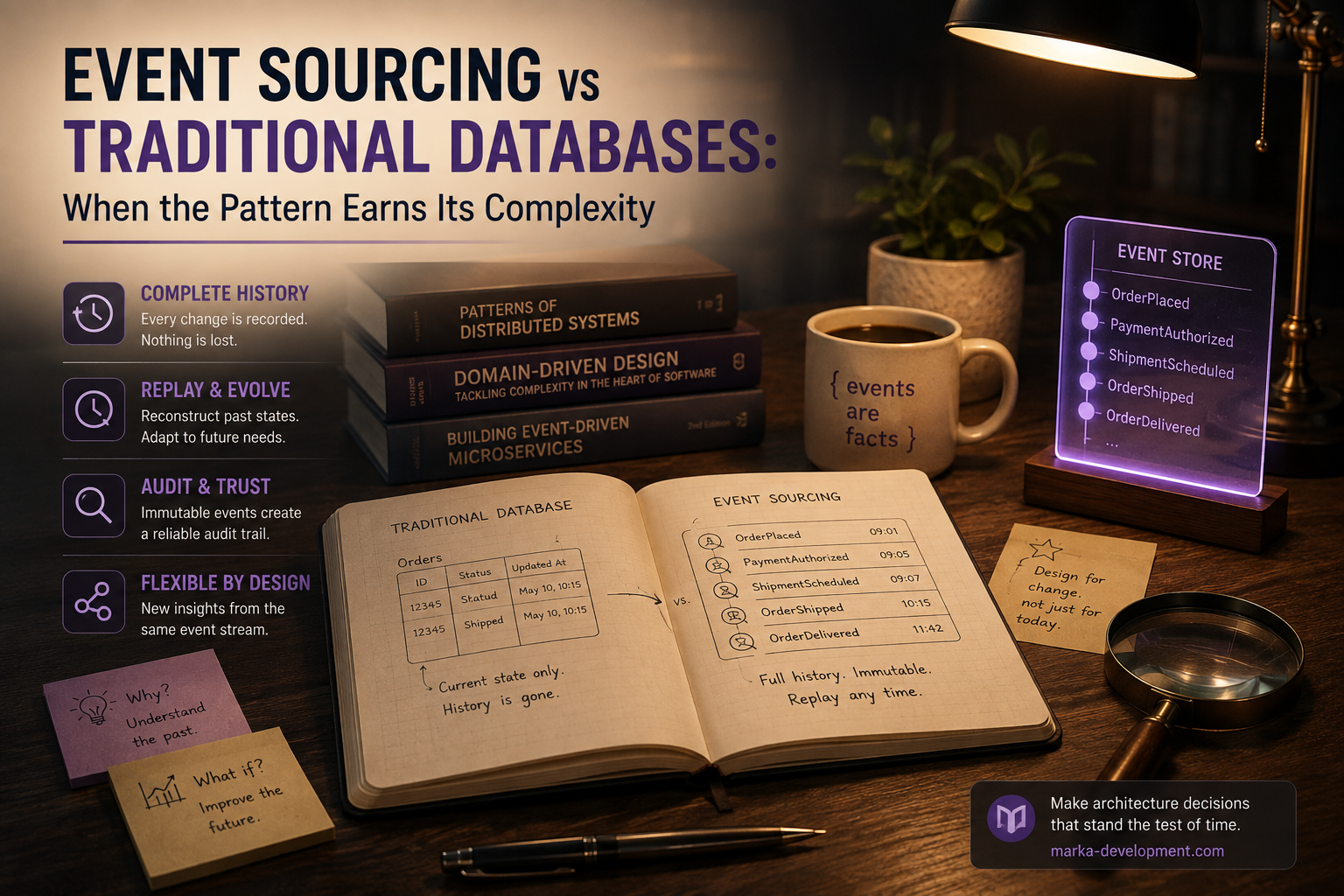
Most applications do not need event sourcing. That is not a warning buried at the end of this article. It is the starting point, because the most expensive mistakes with this pattern happen when teams adopt it for the wrong reasons, drawn in by the architectural elegance of the idea rather than by a genuine need that traditional databases cannot satisfy.
Event sourcing is a persistence pattern where every change to application state is stored as an immutable event in an append-only log. Instead of overwriting a database record with the latest value, you store every change that produced that value. The current state is derived by replaying the history. It is the difference between a bank balance and a bank ledger. The balance tells you where you are. The ledger tells you how you got there, and that distinction changes everything about what the system can do.
For domains where knowing how you got here matters as much as knowing where you are, event sourcing provides capabilities that traditional databases genuinely cannot replicate cleanly: complete audit trails that are the primary data structure rather than an afterthought, temporal queries that reconstruct state at any point in the past, and replay that lets you reprocess historical data through new business logic without losing any history. For domains where only the current state matters, event sourcing adds complexity with no return. A CRUD application that adopts event sourcing because the pattern is interesting will spend the next two years managing that complexity instead of shipping features.
This article covers what the pattern actually is, what traditional databases do better, where event sourcing earns its complexity, the specific failure modes that practitioners consistently encounter, and the decision framework that tells you which architecture fits your use case before you commit to an approach that is genuinely difficult to reverse.
Marka's engineering team works with enterprises across healthcare, manufacturing, finance, and public administration on data architecture decisions at exactly this level of consequence. If your organization is evaluating event sourcing for a production system, the architecture review conversation is worth having before the first sprint. Reach the team at marka-development.com/contacts.
What Traditional Databases Actually Do and Where They Excel
Before evaluating event sourcing, it is worth being specific about what traditional relational and document databases are designed to do well, because their strengths are real and extensive, and the decision to move past them requires genuine justification.
Traditional relational databases store the current state of entities. When an order's status changes from pending to shipped, the row is updated. The previous state is gone. What remains is the present reality of the data, optimized for the queries that need it: give me all open orders, give me this customer's current address, give me the total revenue this month. SQL provides a standardized, powerful, and widely understood mechanism for all of these queries, backed by decades of tooling, documentation, and engineering expertise.
The strengths that relational databases provide are mature and production-proven. ACID guarantees ensure that transactions are atomic, consistent, isolated, and durable. Schema enforcement prevents invalid data from entering the system. Foreign keys maintain referential integrity automatically. Indexing strategies are well-understood and supported by sophisticated query optimizers. The engineering community's collective knowledge of how to operate, scale, backup, and recover relational databases is vast and readily available.
For the majority of applications, these strengths are exactly what is needed. An e-commerce catalog, a user profile service, a content management system, a project management tool: none of these have requirements that traditional databases cannot serve efficiently. The current state of the data is what the application needs, SQL can express any query the application requires, and the operational characteristics of relational databases are well within what modern PostgreSQL or SQL Server deployments can handle.
The limitations of traditional databases for specific use cases are equally specific. Tracking history requires deliberate engineering: audit log tables, soft deletes, created and updated timestamps, and similar mechanisms added on top of the core data model. Temporal queries, answering what was the state of this entity at a specific point in the past, are either impossible or require reconstructing from audit logs in ways that were not part of the original design. Debugging complex state transitions requires understanding what the current state is without knowing the sequence of events that produced it, which is the architectural equivalent of investigating a crime scene after someone has cleaned it up.
What Event Sourcing Actually Is and What It Changes
In an event-sourced system, the event store is the source of truth. Every change to a business entity is stored as a named, immutable event that represents something that happened in the domain. An order does not have a status field that gets updated. It has a history of events: OrderPlaced, PaymentAuthorized, ShipmentScheduled, OrderShipped, OrderDelivered. The current state of the order is derived by replaying those events in sequence.
The immutability is foundational to everything the pattern provides. Once an event exists, it represents an unchangeable fact: this action occurred at this moment with these parameters. This constraint eliminates entire categories of bugs. There are no lost updates from race conditions where two writers overwrite each other. There is no confusion about what changed when. There is no accidental data loss from overwrites. If a bug in the application logic produced incorrect state, the events that produced it are still in the log. The state can be corrected without destroying the history that explains how the incorrect state occurred.
The three capabilities this architecture enables that traditional databases cannot replicate cleanly are the following.
Complete audit trail as the primary data structure. In a traditional database, the audit trail is typically added after the fact: a separate log table, a change data capture mechanism, or application-level logging that may or may not be complete depending on whether every code path remembers to write to it. In an event-sourced system, the audit trail is not a feature added to the architecture. It is the architecture. Every state change is an event. The event log is the database. The audit trail is complete by construction, not by discipline.
Time travel and temporal queries. Because the full history is stored, the state of any entity at any point in the past can be reconstructed by replaying the events up to that point. What was this account's balance on the 15th of last month? What was this order's status at 14:32:07 on the day of the disputed delivery? These questions require replaying the event stream to the specified point, which is computationally more expensive than a traditional query but is architecturally correct in a way that traditional databases cannot replicate without purpose-built audit infrastructure.
Replay for bug fixes and business logic changes. When business rules change, an event-sourced system can replay the historical event stream through the new rules and produce updated projections without losing any history. A pricing model change that needs to be applied retroactively, a compliance requirement that changes how historical data must be reported, a bug fix that requires recalculating derived state: all of these are solved by replay in an event-sourced system and are expensive engineering projects in a traditional database system.
The Complexity That Event Sourcing Actually Introduces
Understanding what event sourcing provides is the first half of the decision. Understanding what it costs is the second half, and the cost is real enough that it eliminates most candidate use cases.
Querying current state requires projections. In a traditional database, querying the current state of an entity is a single SELECT statement. In an event-sourced system, the current state is derived by replaying events. Doing this on every read for a system with millions of events per entity is not viable. Projections, also called read models or materialized views, are derived state representations built by processing the event stream and storing the results in a queryable format. They are the solution to the read problem, and they introduce a system component that must be built, maintained, updated when event schemas change, and rebuilt when business requirements change what the projection needs to contain.
The practical implication is that a CQRS pattern, Command Query Responsibility Segregation, almost always accompanies event sourcing in production systems. The write model is the event store. The read model is one or more projections optimized for specific query patterns. The result is a system with two data representations that must be kept consistent, two sets of code to maintain, and eventual consistency between writes and reads. This is not a theoretical complexity. It is an ongoing engineering and operational burden.
Snapshots are required for long-lived aggregates. Replaying thousands of events to reconstruct an entity's current state is expensive. Snapshots address this by periodically capturing the current state of an aggregate so that replay can start from the most recent snapshot rather than the beginning of time. Snapshots introduce their own engineering concerns: when to snapshot, where to store snapshots, how to invalidate snapshots when business logic changes require a full replay, and how to handle the case where a snapshot is more recent than the events a specific query needs to inspect.
Schema evolution is painful by design. Events are immutable, but event schemas change as business requirements evolve. An OrderPlaced event that was sufficient in year one may need additional fields in year two to support a new feature. The old events, already stored, do not have those fields. The mechanism for handling this is upcasting: transforming old event formats into new formats at read time so that the application code can process all events through a single handler. Upcasting works but requires discipline and tooling that most teams underestimate at the start of an event sourcing project.
Eventual consistency affects user experience. In systems with projections, writes go to the event store and reads come from projections that may lag behind the event store. A user who places an order and immediately queries their order history may not see the new order if the projection has not yet processed the event. Designing around eventual consistency requires careful thought about which queries require strong consistency, which can tolerate eventual consistency, and how to communicate the system's consistency guarantees to users in ways that do not erode trust.
Storage grows indefinitely. Events are never deleted. An event-sourced system's storage requirement is the sum of every event ever written to it. Compaction and archival strategies are needed for long-running systems. The storage cost is typically not prohibitive in 2026's storage pricing environment, but it needs to be planned for rather than discovered after the event store has grown to a size that makes operations expensive.
When Event Sourcing Earns Its Complexity
With the costs understood, the use cases where event sourcing earns those costs are specific and recognizable.
Financial systems. Every financial transaction is an event. The requirement for complete, tamper-evident audit trails, the need for temporal queries to answer regulatory questions about historical account states, and the domain model that naturally expresses itself as a sequence of financial events all align with what event sourcing provides. Banks figured this out before software engineering had a name for it. A bank does not store your balance by overwriting a number. It stores every transaction and derives your balance from replaying them. Event sourcing is the software pattern that formalizes what financial institutions have always done with ledgers.
Healthcare record systems. Patient record histories where every observation, prescription, diagnosis, and procedure must be preserved, traceable, and auditable are natural fits for event sourcing. The compliance requirements of HIPAA and equivalent frameworks in other jurisdictions demand audit trails that traditional databases require deliberate engineering to provide. Event sourcing provides those trails architecturally.
Compliance-heavy enterprise platforms. Any system subject to regulations that require demonstrating what happened, when, and why, including SOX, GDPR data subject request responses that need to show exactly what data was processed and when, and NIS2 audit requirements, benefits from event sourcing's architectural audit trail. In regulated industries, the audit trail is not optional infrastructure that can be retrofitted. It is a first-class requirement, and event sourcing makes it a first-class architectural element.
Systems requiring retroactive business logic application. A pricing engine that needs to recalculate historical invoices under a new pricing model. A risk system that needs to reanalyze historical transactions under a new risk framework. A reporting system that needs to reconstruct what the state of the world was at a specific point in the past for regulatory reporting purposes. These are use cases where replay is not a convenience. It is the architectural requirement that drives the decision.
Collaborative and real-time systems. Multiplayer editing systems, collaborative workflow platforms, and systems where multiple users act on the same entity concurrently and the system needs to reconcile their changes in a coherent way are cases where event sourcing's explicit state transition model provides clarity that mutable state models obscure. Each user's action is an event. The resulting state is a projection of those events applied in sequence. Conflict resolution is explicit in the event model rather than implicit in the last-writer-wins semantics of a mutable database.
The Patterns That Accompany Event Sourcing in Production
Real-world event sourcing implementations in production do not use event sourcing in isolation. They use a composite of three patterns, and evaluating event sourcing without evaluating this composite understates the architectural commitment.
Event Sourcing provides the write model's source of truth: every state change is an immutable event stored in an append-only log. The event store is the database of record.
CQRS separates the write model from the read model. Commands go to the event store. Queries go to projections that are optimized for read patterns. The separation allows each side to be optimized independently: the write model for throughput and consistency, the read model for query performance.
Projections and snapshots make the system usable at production scale. Projections build read models from event streams. Snapshots optimize aggregate rehydration for entities with long event histories. Both are engineering investments that must be maintained alongside the core event store.
The practical architecture of a production event-sourced system also typically includes a message broker for event distribution, multiple projection services consuming the event stream, and separate data stores for different projection types: a relational database for structured query projections, a search index for full-text projections, a cache for frequently accessed derived state. The system is not a single database. It is a collection of components with operational requirements that exceed what a traditional single-database architecture requires.
Event Schema Design: The Decision That Determines Long-Term Success
The single most consequential decision in an event sourcing implementation is the level of abstraction at which events are defined. Two approaches exist, and getting this wrong is the most common source of long-term maintenance problems.
Low-level events map closely to CRUD operations: UserFieldUpdated, RecordStatusChanged, InventoryQuantityAdjusted. These are easy to define initially and feel comprehensive because they capture every change. They are also difficult to work with over time because they express what changed rather than why it changed. A sequence of UserFieldUpdated events does not tell you whether the user changed their own name or an administrator corrected a data entry error. The business meaning is lost.
High-level business events capture intent: OrderPlaced, PaymentProcessed, ShipmentConfirmed, RefundApproved. These require deeper domain understanding to define correctly and are harder to model at the start of a project when the domain is still being understood. They are significantly more maintainable over time because they express meaningful business facts that remain stable even as implementation details change. Domain-driven design's ubiquitous language directly informs this level of event design.
The practical recommendation from practitioners who have built and operated event-sourced systems in production consistently is to design business-level events from the start, even when it requires more upfront domain modeling work. The cost of migrating a low-level event model to a business-level event model after the system is in production is one of the most expensive refactoring projects in software development.
The Hybrid Approach: When Neither Extreme Is Right
Pure event sourcing applied uniformly across an entire system is a theoretical construct. Production systems that succeed with event sourcing almost universally apply it selectively, to the bounded contexts where its capabilities are genuinely needed, while using traditional databases for the parts of the system that do not need those capabilities.
An e-commerce platform might apply event sourcing to its order management and payment processing domains, where audit requirements and temporal queries are genuine business needs, while using a traditional relational database for its product catalog, user profiles, and content management. The event store handles the compliance-critical, audit-required portions. The relational database handles the CRUD-appropriate portions. The two coexist with clear boundaries between them.
This hybrid approach, often formalized as applying event sourcing within specific bounded contexts in a domain-driven design, reduces the architectural commitment to the portions of the system that genuinely benefit from it. It also reduces the risk of the decision: if the event sourcing portion proves difficult to operate or harder to evolve than anticipated, the blast radius is limited to that bounded context rather than the entire system.
For organizations on Microsoft's stack, Azure Event Hubs and Azure Cosmos DB provide the infrastructure foundation for event sourcing implementations that need to scale to enterprise workloads. Azure Event Hubs serves as the event log with retention and replay capability. Cosmos DB's change feed provides the projection building mechanism. Azure Service Bus handles event distribution to projection consumers. Marka's Cloud and Platform Modernization practice implements this stack for enterprise clients where the audit and temporal query requirements of regulated industries make event sourcing the right architectural choice.
The Decision Framework: Four Questions That Determine the Right Architecture
Before committing to event sourcing, four questions produce the honest answer about whether the pattern earns its complexity for your specific use case.
Does your domain require a complete, tamper-evident audit trail as a first-class requirement? If yes, and if that audit trail must be the source of truth rather than a derived artifact, event sourcing provides it architecturally rather than by engineering discipline. If the audit trail is a reporting feature rather than a compliance requirement, a traditional database with deliberate audit logging is sufficient and significantly simpler.
Do you need to reconstruct the state of entities at arbitrary points in the past? Temporal queries of this kind are expensive to implement correctly on top of traditional databases and are natural operations on an event store. If your business requirements include regulatory reporting that requires point-in-time state reconstruction, or debugging workflows that require understanding what the system state was at a specific moment during an incident, event sourcing addresses these requirements architecturally. If your historical queries are limited to reporting on current state over time, traditional databases with proper indexing are sufficient.
Does your domain require replaying historical events through new business logic? If your business rules change in ways that require retroactive recalculation of derived state, replay is the mechanism that makes this possible without losing historical context. If your business rules are stable and retroactive recalculation is not a requirement, this capability is not worth the complexity it brings.
Does your team have the capacity to learn and operate the composite pattern correctly? Event sourcing with CQRS, projections, and snapshots requires engineering expertise that most teams do not have at the start of an event sourcing project. The learning curve is real, and the failure modes of getting it wrong in production are expensive. If the team capacity for this learning investment does not exist, a simpler architecture that can be operated correctly is better than a sophisticated architecture that is operated incorrectly.
If the first three questions answer yes and the fourth is a commitment the organization is prepared to make, event sourcing earns its complexity. If any of the first three answers no, the pattern adds complexity without proportionate return.
What the Right Architecture Decision Actually Requires
The pattern that produces the most expensive mistakes in this decision is not choosing the wrong database technology. It is making the choice before the requirements are specific enough to evaluate it honestly.
Event sourcing is not a better version of a traditional database. It is a different tool for a different job, and the job it is built for involves audit completeness as a first-class architectural requirement, not as a reporting feature. If your compliance function needs to demonstrate a complete, tamper-evident record of every state change in a system, and that requirement is non-negotiable, event sourcing provides it structurally in a way that no traditional database can replicate without significant deliberate engineering on top of its core design.
If that requirement does not exist in your domain, the question is not which database to use. It is whether the additional capability event sourcing provides is worth the additional complexity it introduces across every dimension of the system: development, operations, schema evolution, team onboarding, and incident response.
For most systems the answer is no, and choosing a well-designed relational or document database and operating it correctly is the better decision. For systems in financial services, healthcare, regulated manufacturing, or public sector platforms where the audit trail is the point, not the side effect, the answer is often yes, and the architectural investment pays for itself in the reduced cost of compliance evidence production over the system's operational life.
Getting that determination right before the first sprint is the work that determines whether the architecture serves the system for the next decade or becomes the constraint that limits what the system can become.
Marka's engineering team has delivered data architecture decisions at exactly this level of consequence across healthcare, manufacturing, financial services, and public administration for over thirty years. If your organization is making this call now, the right conversation is an architecture review before a technology commitment. You can start that conversation at marka-development.com/contacts or review the platform and data architecture work the team delivers for enterprise clients.