Digital Transformation in the Age of Agentic AI: Which Models Still Apply Today
Digital transformation models were built when humans were the binding constraint. Agentic AI changes the constraint. Here is which models survive that shift and which need reframing.
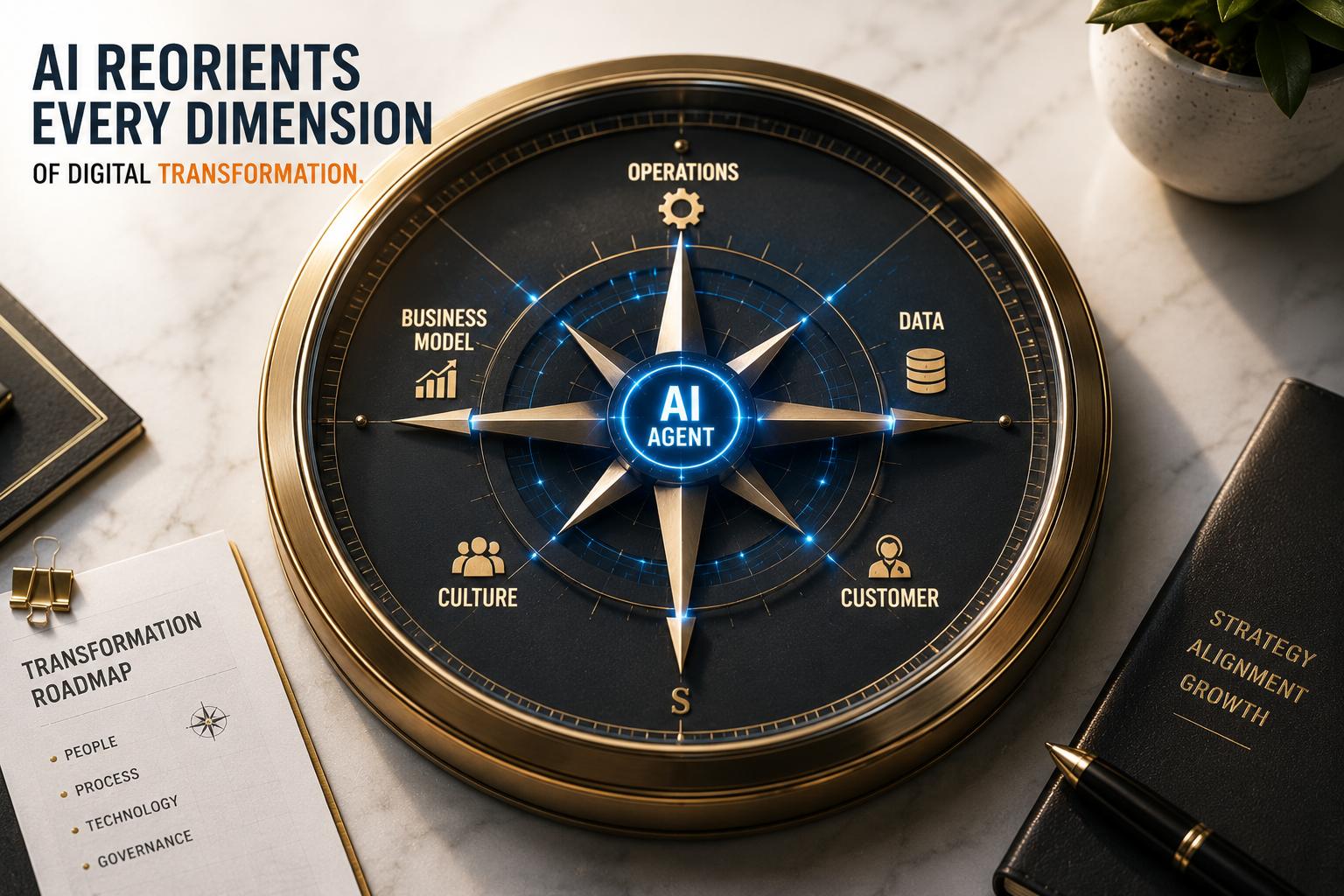
Digital transformation frameworks were built for a world where humans were the binding constraint. Every model, whether customer-centric, operational, data-driven, or cultural, assumed that people would interpret context, make decisions, and initiate action. Technology existed to extend what humans could do. The architecture that followed from that assumption shaped three decades of enterprise system design.
Agentic AI changes the constraint. Software can now reason, plan, act across multiple systems, and execute complex multi-step workflows without a human initiating each step. The enterprise architecture built for human bandwidth as the bottleneck does not automatically support systems where the bottleneck is data quality, integration surface, and governance design. This is not an incremental shift in how technology gets deployed. It is a foundational change in what enterprise architecture is actually for.
The evidence of that change is not theoretical. Gartner projects that 40 percent of enterprise applications will embed task-specific AI agents by the end of 2026, up from less than 5 percent in 2025. McKinsey puts the value potential of agentic AI at $2.6 to $4.4 trillion annually across more than 60 use cases. Yet nearly 80 percent of companies using generative AI in some form report no material bottom-line impact at the enterprise level. The gap between experimentation and production-scale transformation is wide, and it is not closing because organizations are choosing the wrong AI. It is closing because they are running agentic AI on architectures that were never designed to support it.
The question this article answers is specific: which of the established digital transformation models still apply in the agentic era, which need to be reframed, and what has genuinely changed about how enterprise teams should approach transformation strategy in 2026.
Marka's team works with enterprises across healthcare, manufacturing, finance, and public administration on exactly the intersection of legacy architecture and transformation strategy that agentic AI now forces into sharper focus. If your organization is navigating this decision now, you can reach the team at marka-development.com/contacts.
The Gen AI Paradox That Makes Traditional Models Fail
Before evaluating which transformation models still apply, it is worth understanding precisely why so many digital transformation programs are stalling at the point where agentic AI enters them.
McKinsey's research describes this as the gen AI paradox: nearly eight in ten companies report using generative AI in at least one business function, yet just as many report no significant bottom-line impact. The mechanism behind the paradox is structural. Most organizations deployed AI horizontally, as enterprise-wide copilots and chatbots that scale quickly but deliver diffuse, hard-to-measure gains. The more transformative vertical deployments, function-specific AI that automates end-to-end business processes, remain stuck in pilot mode in approximately 90 percent of cases.
Agentic AI offers a path out of this paradox precisely because agents are not reactive tools. They are goal-driven systems that combine autonomy, planning, memory, and integration to automate complex processes end-to-end. But reaching production scale with agents requires something that most traditional digital transformation models did not anticipate: the organization must be ready not just to deploy AI, but to redesign the workflows, data architecture, and governance structures that determine whether agents can operate reliably.
Deloitte's 2026 Tech Trends report frames this plainly: 42 percent of organizations are still developing their agentic AI strategy, while 35 percent have no strategy at all. Gartner predicts that 40 percent of agentic AI projects will fail by 2027, not because the technology does not work, but because organizations are automating broken processes instead of redesigning operations. The pattern separating success from failure is consistent: redesign, then automate. Not the other way around.
This reordering is the lens through which each transformation model needs to be evaluated.
The Operational Process Model: Still Valid, Fundamentally Upgraded
Of the established digital transformation models, the operational process model retains the strongest direct applicability in the agentic era. Its core premise, that internal workflows can be systematically redesigned and automated to reduce errors, costs, and cycle times, maps directly to what agentic AI delivers at its best.
What changes is the scope and depth of what "operational transformation" now means. Earlier iterations of this model targeted specific workflows in isolation: automate the invoice approval, digitize the customer onboarding, connect the warehouse management system to the ERP. Agentic AI enables cross-system process execution that those earlier approaches could not achieve. An agent that handles a complex refund can verify the original transaction, check return-policy eligibility, process the refund in the payment system, and update both the order-management and accounting systems, completing a task that previously required separate tickets across multiple teams, without a human initiating each step.
PwC's 2026 Digital Trends in Operations Survey of 767 operations leaders found that 83 percent of respondents say AI agents and automation will accelerate the breakdown of traditional functional silos. Yet only 27 percent have fully embedded an AI strategy across business units, and just 37 percent are comfortable assigning AI agents to execute full end-to-end processes in operations. The operational transformation model is as relevant as it has ever been. The blocker is no longer the model itself but the readiness of the data and integration architecture to support agents executing across those operations.
For enterprise teams applying the operational process model in 2026, the practical upgrade is this: the workflow redesign must precede the agent deployment. Agents that are plugged into existing broken processes automate the broken process. The organizations that are generating measurable returns are the ones that map end-to-end workflows first, identify the steps where agent autonomy adds the most value, and then design the data access and integration surface those agents will need to operate reliably.
The Data-Driven Transformation Model: Now a Prerequisite, Not a Strategy
The data-driven transformation model was designed as an approach to embed data and analytics into decision-making across the organization. In the agentic era, it is no longer a transformation model that organizations can choose to adopt or defer. It is the prerequisite on which every other model depends.
McKinsey's April 2026 research on scaling agentic AI is unambiguous: success with agentic AI depends on a data architecture that supports increasing levels of autonomy, coordination, and real-time decision-making, typically modular and interoperable frameworks that give agents reliable access to the data they need to operate safely. Because agentic AI coordinates multiple models and data sources continuously, often without human intervention, it requires tighter and more automated governance than generative AI alone.
The practical consequence for enterprise transformation strategy is that organizations cannot sequence data modernization after AI deployment. The sequence must be reversed. Data architecture readiness, including real-time access, consistent schemas across systems, end-to-end lineage, and automated quality controls, determines whether an agentic system can function reliably in production. An agent operating on stale, fragmented, or poorly governed data does not produce slow outputs. It produces unreliable ones, and unreliable agent behavior in a production enterprise environment is the fastest way to lose organizational trust in an AI program entirely.
This reframes how the data-driven transformation model should be positioned internally. The framing is no longer "we are going to become a data-driven organization as a strategic goal." The framing is "our AI transformation cannot reach production scale until our data architecture supports it, and here is the specific work that needs to happen first." That is a more concrete and time-bounded argument that connects to the AI investment the board has already approved.
The Customer-Centric Model: Deeper, Not Displaced
The customer-centric transformation model remains fully valid. What changes is the depth at which AI can now execute on its core premise: using technology to anticipate customer needs and deliver personalized experiences at scale.
The surface-layer deployment of this model, the chatbot that deflects basic inquiries, is the version that has already been widely adopted and widely found wanting. The more significant shift in 2026 is the emergence of agents that resolve customer issues end-to-end across systems that were never designed to communicate with one another. Cross-platform access provisioning is one example: for enterprise IT support, an agent can receive a new-hire request, provision accounts across identity management, email, collaboration tools, and line-of-business applications, then confirm completion, a task that traditionally required separate tickets across multiple teams.
The enterprise implication is that the customer-centric model now requires a different set of architectural decisions than it did in 2020. Building genuinely customer-centric AI experiences means exposing backend systems to agent execution in ways that most enterprise architectures are not currently designed to support. The customer experience layer can only be as responsive and personalized as the systems beneath it allow agents to reach and act upon.
CIO.com's 2026 digital transformation outlook captures this well: in customer support, agentic AI will manage routine requests while human agents address complex issues with empathy and nuance, guided by AI insights and recommendations. The architecture that enables this is the composable integration layer that allows agents to act across systems, not just the customer-facing AI interface itself.
The Business Model Transformation: The Highest Stakes, The Longest Runway
Business model transformation, the deliberate shift from traditional revenue structures to digitally enabled frameworks, is where agentic AI carries the highest potential and the longest implementation timeline. It is also where the failure rate is highest, because it requires organizational, governance, and architectural alignment that the other models can build toward incrementally.
Forrester's 2026 predictions for enterprise software capture the structural shift: in 2026, enterprise applications will move beyond the traditional role of enabling employees with digital tools to accommodating a digital workforce of AI agents. Tech leaders will be forced to decide how far to go in digitizing business processes and orchestrating workflows independent of human workers. This is a business model question as much as a technology question. The organizations that are navigating it successfully are the ones that have defined governance before deploying agents at scale, not after.
The specific failure mode in business model transformation with agentic AI is deploying agents in ways that create new revenue or operational models without the governance structures that make those models defensible. In regulated industries, healthcare, financial services, manufacturing, and public administration, agent autonomy without clearly defined decision boundaries, audit trails, and human oversight mechanisms creates regulatory exposure that can invalidate the business model the transformation was designed to enable.
McKinsey's framework for the agentic AI mesh addresses this directly. A governance framework defines agents' autonomy levels, decision boundaries, and oversight mechanisms before the agents are deployed into business-critical workflows. Enterprise architecture, over time, is reshaped by agents as they become the connective tissue of day-to-day operations. But that reshaping needs to be deliberate, not emergent.
The Cultural and Organizational Model: The Hardest to Reframe
The cultural and organizational transformation model was built around helping people change how they work with technology. In the agentic era, the question is no longer just how people work with technology, but how people work alongside systems that can act autonomously.
McKinsey's research on moving beyond pilots to enterprise impact identifies that some companies have introduced entirely new roles, including agent orchestrator and human-in-the-loop designer, as part of their organizational transformation for the agentic era. Employees need to be equipped for a world of human-agent collaboration, which is a fundamentally different capability development challenge than training people to use new software.
McKinsey's April 2026 research on redesigning the technology workforce frames the CIO's challenge as becoming architects of change: CIOs can no longer treat hiring, capability building, and vendor strategy as separate decisions, because in an agentic environment these levers reinforce one another. Hiring determines where human judgment sits in the organization. Capability building determines whether AI amplifies that judgment or bypasses it.
The cultural model still applies, but the change management scope is larger than previous iterations anticipated. The organizations that handle this well define clearly which decisions remain with humans, which are delegated to agents with oversight, and which are fully autonomous. That clarity is an organizational design question before it is a technology question, and it is the cultural work that enables everything else.
The Two Architecture Paths: Incremental vs Comprehensive
Running through all of the transformation models above is a foundational decision that determines how quickly organizations can move and how much risk they carry in the process. McKinsey's March 2026 research on enterprise architecture for the agentic era frames this as two primary paths: incremental integration, which entails deliberately adding agentic AI into existing systems over time, or comprehensive transformation, which requires a complete overhaul to support agentic workflows from the ground up. Incremental integration allows companies to quickly deploy agents into the tech stack, but the piecemeal approach can increase technical debt and ultimately slow progress. Comprehensive transformation sets companies up for long-term success, but the extended implementation timeline creates short-term disadvantage.
Most organizations will not choose cleanly between these paths. They will pursue what McKinsey calls domain-based modernization: comprehensive transformation in the highest-value domains, incremental integration everywhere else, with both connected through an agentic mesh that provides a unified orchestration layer.
McKinsey's April 2026 research on reimagining tech infrastructure for agentic AI identifies four foundational capabilities that this architecture requires: repeatable and executable actions through secure APIs with embedded policy checks, reliable operational data with clear sources of truth for assets, dependencies, and logs, imperfect data should not prevent progress since many high-value use cases can be piloted in environments with inconsistent data fidelity, and an orchestration layer that connects agents, tools, and enterprise systems through a shared coordination mechanism.
The practical implication for enterprise teams is that the architecture decision needs to be made explicitly, not by default. Organizations that never make a deliberate choice between incremental and comprehensive paths typically end up with a patchwork of agent deployments that create new integration complexity without delivering the cross-system value that makes agentic transformation worthwhile.
What the Models That Still Apply Have in Common
Reviewing the established transformation models against the agentic AI context reveals a consistent pattern. The models that remain applicable are the ones whose core premise survives the shift from human-initiated to agent-initiated workflows. The ones that need reframing are the ones whose implementation assumptions were built around human bandwidth as the constraint.
The operational process model survives because systematically redesigning and automating workflows is exactly what agents enable, at a depth and cross-system scope that earlier automation could not reach. The data-driven model survives but is elevated from strategy to prerequisite. The customer-centric model survives but requires backend architectural enablement that the surface-layer AI deployments of the last three years did not need. The cultural and organizational model survives but must expand its scope to include human-agent collaboration design, not just change management for new software.
What none of the traditional models fully anticipated is the governance dimension that agentic AI adds. When AI can act autonomously across systems, the governance structures that define what agents are permitted to do, what requires human oversight, and how agent decisions are audited become load-bearing parts of the transformation architecture. In regulated industries, those governance structures are not optional design elements. They are the conditions under which the transformation is legally permitted to operate.
The Marka Approach: Architecture First, Transformation Second
The enterprises that convert digital transformation investment into production-scale agentic AI share a consistent approach. They treat architecture readiness as the prerequisite for transformation model selection, not the output of it. They do not choose a transformation model and then discover the architectural constraints that prevent them from executing it. They assess the current architectural state, identify the specific gaps against agentic AI requirements, and use that assessment to determine which transformation models can be executed now, which need phased architectural work, and which represent longer-term strategic direction.
Marka's Cloud and Platform Modernization practice is built around exactly this sequence. For organizations on Microsoft's stack, the Azure-native toolset provides the integration surface, orchestration capability, and governance infrastructure that agentic transformation requires, without necessitating a full infrastructure replacement before the first agent goes into production. The industries Marka works in, healthcare, manufacturing, financial services, and public administration, are also the industries where the governance dimension of agentic transformation carries the most regulatory weight and the most enforcement risk. That combination of technical depth and sector-specific compliance experience is where the team's value in transformation engagements is most direct.
The starting point for most of these engagements is not a transformation model selection. It is an architecture review that establishes what the current state can support, what it cannot, and what the sequenced path looks like from where the organization is now to where its transformation strategy requires it to be.
If your organization is working through this question, you can reach Marka's team at marka-development.com/contacts or review the full scope of Enterprise Management and Modernization work the team delivers.
What to Do Next
Three questions are worth working through before your next transformation planning cycle or board-level AI investment review.
Which of your current transformation initiatives assume human-initiated workflows that agents could take over? The answer identifies where agentic AI creates the most immediate value and where the current process design needs to change before agent deployment begins. Automating a workflow designed for human initiation without redesigning it is the pattern that produces the failure statistics Gartner and Deloitte are measuring.
Does your current data architecture support the real-time access and end-to-end lineage that agentic AI requires? The data-driven transformation model is no longer a strategic choice. It is the infrastructure question on which every other model depends. If the answer to this question is no, it belongs at the top of the modernization roadmap before the agent deployment roadmap.
Have you defined the governance structures that determine agent autonomy, oversight requirements, and audit trails in your specific regulatory context? In regulated industries, this is the work that determines whether transformation programs are legally defensible when they reach production scale. Building governance into the transformation design rather than retrofitting it after deployment is consistently the more resilient and less expensive path.
The enterprises that get ahead of these questions in 2026 will be significantly better positioned when agentic AI shifts from a competitive differentiator to a table-stakes operational capability. That shift is already underway. The window for deliberate preparation rather than reactive response is the work worth doing now.