AI Product Discovery for Ecommerce: How Conversational Agents Replace Search
Conversational AI agents are replacing keyword search as the primary product discovery channel. Here is the architecture your ecommerce platform needs to remain visible.
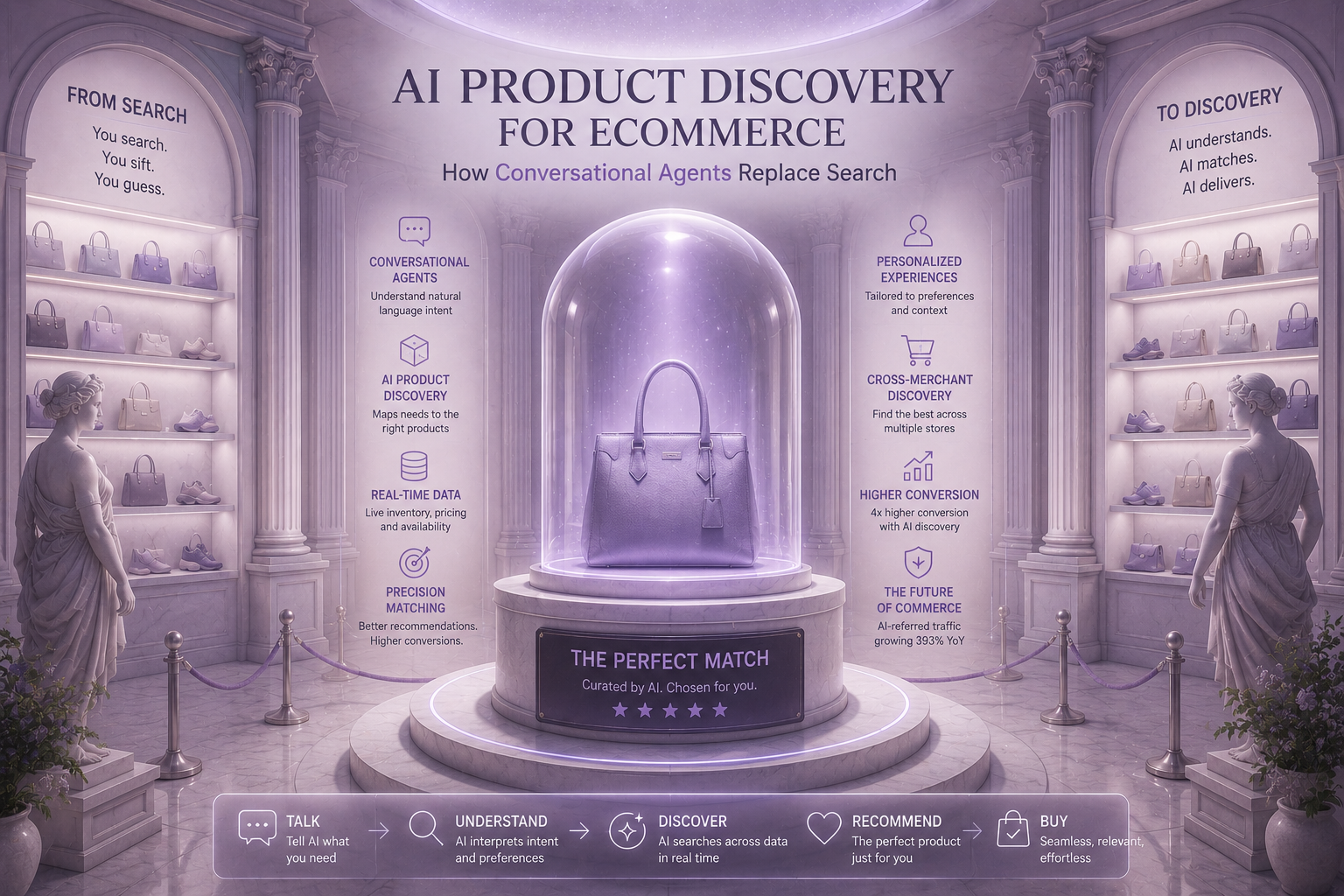
For fifteen years, ecommerce product discovery meant one thing: a search box, a keyword, and a results page. The customer did the work. They searched, browsed, filtered, clicked, compared, read reviews, and decided. The store's job was to appear in the search, load fast enough, and convince through design and copy. That model worked when search was the only channel that reached customers at the moment of purchase intent.
That moment has shifted.
AI-referred traffic to US retail sites grew 393% year-over-year in Q1 2026, according to Adobe data. On Black Friday 2025 alone, the year-over-year growth was 805%. More significantly, the quality of that traffic has reversed. In March 2025, AI-referred visitors converted 38% worse than non-AI traffic. By March 2026, the same metric had flipped to 42% better. Adobe also reports that AI-referred visitors spend 48% longer on retail sites and browse 13% more pages per visit. They arrive already matched to a product through a conversational interface. They are not browsing. They are buying.
The mechanism behind this shift is conversational product discovery, specifically AI agents that understand natural language intent, access live product data across merchants, compare attributes against stated preferences, and surface a specific recommendation rather than a list of results. The customer says "I need a laptop for video editing under 2,000 euros that fits in a carry-on" and the agent returns a recommendation, not a results page.
This article covers what conversational product discovery is, how it works technically, what it means for ecommerce architecture, and what enterprise teams need to build now to remain visible as this channel grows from 1.5 percent of retail spend today toward the 15 to 25 percent Bain projects by the end of this decade.
Marka's team works with enterprises across healthcare, manufacturing, finance, and public administration on AI-powered platform development, including the data infrastructure and API architecture that makes ecommerce platforms readable to AI agents. If your organization is evaluating this challenge now, reach the team at marka-development.com/contacts.
Why Keyword Search Cannot Compete With Conversational Discovery
Keyword search has a structural limitation that conversational AI removes: it requires the customer to translate their actual need into words that match your product data. A shopper who wants "something breathable for hot yoga that does not show sweat" needs to already know the product vocabulary before keyword search can help them. They need to search "moisture-wicking athletic wear" or "seamless yoga leggings" and hope the results match what they meant. If the translation fails, the search fails.
Conversational agents work in the opposite direction. The customer states the need in natural language and the agent does the translation. It maps "breathable for hot yoga that does not show sweat" to moisture-wicking fabrics, seamless construction, dark colorways, and specific performance certifications. It then queries product data across multiple sources, applies the mapping, and returns a specific recommendation with the reasoning behind it.
The conversion rate data reflects this difference. Shoppers who engage with AI-powered conversational interfaces convert at 12.3 percent, compared to 3.1 percent for shoppers who do not, a fourfold difference according to Rep AI's analysis of 17 million shopper interactions. McKinsey puts AI-generated product recommendations at 4.4 times higher conversion rates than traditional search. Brands early to conversational discovery report 38 percent jumps in average order value from AI-assisted shopping. The performance gap between keyword search and conversational discovery is not marginal. It is structural, and it reflects the difference between asking customers to speak your product data's language and building a system that speaks theirs.
How Conversational Product Discovery Actually Works
The architecture behind conversational product discovery involves four components that work in sequence. Understanding each one is the prerequisite for understanding what ecommerce platforms need to support.
Natural language intent parsing. The agent receives a customer request in plain language and extracts structured intent: product category, functional requirements, aesthetic preferences, constraints (price, size, compatibility), and context (gift, personal use, urgency). This is where large language models do their most valuable work in commerce. The LLM does not match keywords. It understands that "for my husband who commutes by bike and works in a creative agency" implies waterproof, professional appearance, high visibility for safety, and probably urban aesthetic. That interpretation happens before any product data is queried.
Protocol-based product data access. The agent queries merchant product data through structured protocols. The most significant in 2026 are the Model Context Protocol (MCP) for tool-calling and data access, the Agent-to-Agent protocol (A2A) for multi-agent coordination, and the Universal Commerce Protocol (UCP) for cross-merchant product discovery and checkout. These protocols allow an agent to query a merchant's product catalog, inventory levels, pricing, and availability in real time without requiring a bespoke integration for each merchant. According to Google's Developer Blog, agents query business profiles to identify available services and negotiate supported features, reducing the need for pre-built integrations at the merchant level.
Attribute-to-product matching. The extracted intent is matched against the structured product data the agent retrieves. This is where product data quality determines whether the agent can recommend your product or cannot. An agent querying for "waterproof hiking boots with ankle support under 150 euros" needs product data that contains waterproof rating, ankle height classification, pricing in the requested currency, and availability data. If that structured data does not exist in a format the agent can parse, the product is invisible to the query regardless of how relevant it actually is. Data comes first. Protocols come second. An MCP integration without structured product data is a connection to empty shelves.
Recommendation generation and transaction execution. The agent generates a recommendation with reasoning: why this product matches the stated need, what trade-offs exist, what alternatives exist. In agentic commerce platforms with checkout integration, the agent can execute the transaction within the same conversation. The customer never visits the store's product page. The store is a data source the agent pulls from, not a destination the customer navigates to.
This last point is the one that most ecommerce teams have not yet fully internalized. Morgan Stanley predicts that nearly half of online shoppers will use AI shopping agents by 2030, accounting for approximately 25 percent of their spending. By the time that adoption curve reaches its midpoint, the merchants whose product data is not agent-readable will be functionally invisible to a quarter of the market.
The Product Data Problem That Blocks Conversational Discovery
The reason conversational discovery is not yet delivering full value for most merchants is not the AI. It is the product data. The 4.4 times higher conversion potential that McKinsey identifies exists specifically for merchants whose data infrastructure can support agent requirements. Most enterprise ecommerce platforms were not built to that standard, because the standard did not exist when most of them were built.
Traditional ecommerce product data was optimized for keyword search and human browsing. Product titles were keyword-stuffed to rank in search. Product descriptions were written to persuade humans, not to be parsed by AI. Attributes were inconsistently structured across categories, because the human could infer what was meant. None of those optimizations help an AI agent.
What agents need is structured, attribute-rich, machine-readable product data that maps to the natural language categories customers use. The specific requirements are the following.
Complete attribute coverage. Every product attribute that a customer might express as a preference needs to be a structured field in the product data, not buried in unstructured description text. Material composition, fit characteristics, compatibility specifications, performance ratings, care requirements, and similar attributes are the fields that allow an agent to match a conversational request to a specific product. If these exist only in prose descriptions, the agent may or may not extract them correctly. If they exist as structured fields, the match is reliable.
Consistent taxonomy across categories. Agents compare products across a category. Inconsistent attribute naming within a category makes cross-product comparison unreliable. If some products list "100% merino wool" and others list "merino" and others list "wool blend" for the same type of attribute, the agent cannot reliably compare them on that dimension. Taxonomy standardization is unglamorous infrastructure work that has very high leverage on agent performance.
Real-time inventory and pricing. Agents query products at the moment of conversation, which means inventory and pricing data that are not updated in real time create a class of failure that damages customer trust faster than almost anything else. An agent that recommends a product confidently and then discovers it is out of stock at checkout has destroyed the trust advantage that conversational discovery creates. Real-time data access requires streaming data pipelines, not batch-synchronized product feeds.
Review and social proof data in structured format. Agents increasingly use review data to support recommendations. Customers ask "is this reliable" and the agent needs access to aggregated review sentiment, common complaints, and rated attributes to answer accurately. Review data trapped in unstructured text on a product page is accessible to humans and largely inaccessible to agent queries.
The Architecture Ecommerce Platforms Need for Agent Readiness
Agent readiness for ecommerce platforms is an architecture question before it is a product data question. The data quality improvements described above are only accessible to agents if the underlying platform architecture exposes them through the right interfaces.
API-first product catalog. An ecommerce platform needs to expose its product catalog through a well-structured API that supports attribute-level querying, real-time inventory checks, and pricing data without requiring a full product page request. Legacy ecommerce platforms that serve product data through page-rendering requests are not natively compatible with agent query patterns. The API layer needs to be purpose-built for machine consumption, not adapted from a human-browsing interface.
MCP server implementation. The Model Context Protocol is emerging as the standard by which AI agents access external data and tools. An ecommerce platform that implements an MCP server exposes its product catalog, inventory, and checkout capability to any AI agent that supports the protocol, which as of 2026 includes ChatGPT, Claude, Gemini, Perplexity, and every major shopping agent built on these models. The implementation investment is made once and delivers access across the entire agent ecosystem.
Streaming data infrastructure. The real-time data requirement described above requires a streaming data architecture behind the product catalog. Change data capture from the inventory management system, pricing engine, and order management system needs to flow continuously into the product data layer that the API and MCP server expose. Batch-synchronized product feeds, where inventory and pricing are updated on a schedule, create the staleness problem that produces the recommendation-to-checkout failure mode.
Structured checkout integration. Agent-mediated checkout, where the transaction executes within the AI conversation without the customer visiting the store, requires a checkout API that the agent can call with sufficient product, quantity, payment, and shipping parameters. This is the zero-click commerce model that is already live at Target, Sephora, Nordstrom, and Best Buy through ChatGPT's shopping integration. For enterprise ecommerce platforms without this capability, the agent can discover and recommend but cannot complete the transaction, leaving conversion on the table at the moment of highest purchase intent.
What Answer Engine Optimization Means for Product Discovery
The shift from keyword search to conversational discovery also changes how ecommerce brands need to think about visibility. Search engine optimization was built around keywords, backlinks, and page authority signals that determine ranking in a results list. Answer engine optimization, the discipline emerging around AI visibility, works through different mechanisms.
AI agents recommend products based on structured data completeness, brand credibility signals across the web, review sentiment and volume, and the clarity with which product attributes match the natural language of customer queries. Brands with clear, consistent product narratives that match how customers talk about their needs are recommended with more confidence and frequency than brands whose product language is optimized for search keywords that no longer apply.
The practical implication is that product copy written to rank in Google keyword results is now working against conversational discovery visibility. "Premium moisture-wicking performance athletic wear for high-intensity training" is a keyword phrase. "Breathable training top that stays dry during hot yoga" is how a customer describes their need. The brand that writes product descriptions in customer language rather than search language is the brand the agent can confidently recommend.
73 percent of consumers are already using AI in their shopping journey, including 45 percent for product ideas, 37 percent for review summarization, and 32 percent for price comparison. The customers who use AI for product discovery are precisely the customers who will never reach your keyword-optimized search results. They bypassed the search box entirely.
How to Assess Your Platform's Conversational Discovery Readiness
Four questions determine where your current ecommerce architecture sits against agent readiness requirements.
Can an AI agent query your product catalog and get structured attribute data in real time? If the only way to access your product data is through a human-facing product page, you are not agent-readable. The answer to this question determines whether agents can discover your products at all.
Does your product data include the attributes customers use in natural language, as structured fields rather than prose descriptions? If material, fit, compatibility, performance, and similar attributes exist only in description text, agent matching is unreliable. Structured attribute data is the difference between products that agents can confidently recommend and products that agents occasionally mention.
Is your inventory and pricing data updated continuously or on a batch schedule? If batch, the staleness problem is active and will produce recommendation-to-checkout failures that erode customer trust in agent-mediated shopping from your store specifically.
Does your checkout process support API-based transaction execution? If not, you are visible to agents but cannot convert within the conversation. The shopper has to leave the agent interface and visit your site, which reintroduces the friction that conversational discovery exists to remove.
The Build Decision: Platform Adaptation vs Custom Architecture
Most enterprise ecommerce platforms in 2026 were built before agent readiness was a design requirement. The question is whether existing platforms can be adapted to meet agent requirements or whether the gaps are architectural enough to warrant a purpose-built approach.
Platform adaptation works when the gaps are in the data layer and the API surface rather than in the core architecture. An existing platform with a functional product catalog, real-time inventory management, and an active development team can typically be extended with an MCP server, a structured attribute taxonomy project, and a checkout API extension. The timeline for this work is typically three to six months for a platform that has the underlying data quality. The result is agent readiness built on top of an existing platform without a core rewrite.
Custom architecture is the right decision when the core platform was built around a page-rendering model that cannot be cleanly extended with an API-first layer, or when the data model itself requires restructuring that a taxonomy project cannot achieve on top of the existing schema. In these cases, the adaptation cost over three years frequently exceeds the cost of a purpose-built platform that is agent-ready from the ground up.
Marka's Cloud and Platform Modernization practice works with enterprise ecommerce teams at exactly this decision point. The starting point is a readiness assessment that maps the current platform architecture against the four agent readiness questions above, identifies where adaptation is sufficient and where architectural change is required, and produces a cost comparison across both paths over a three-year horizon. The assessment is the work that determines whether you are adapting or rebuilding, and it is significantly cheaper to run before a project starts than to discover mid-development that the adaptation approach has architectural limits that prevent it from reaching the required outcome.
What to Do Next
Three actions are worth taking now, before the agent traffic curve reaches the point where missing infrastructure creates a revenue gap that is visible in the numbers.
Audit your current agent visibility. Query your products through ChatGPT Shopping, Perplexity, Google's AI Mode, and Gemini with the natural language requests your customers use. If your products do not appear in recommendations for queries you should be winning, you have a data readiness gap. The audit takes a day and tells you more about your actual agent visibility than any analytics dashboard.
Run the four readiness questions against your current platform. Document the answers. The gaps in those answers are your agent readiness roadmap. Prioritize structured attribute data and real-time inventory access first, because those two capabilities determine whether agents can discover and confidently recommend your products. API and checkout integration follow once the data layer is solid.
Evaluate the adaptation vs rebuild decision with complete information. The cost comparison needs to account for the ongoing cost of maintaining compensating solutions for architectural limitations, not just the upfront cost of each path. An adaptation approach that requires permanent workarounds to achieve agent readiness may cost more over three years than a purpose-built architecture that is agent-ready from the start.
Marka's team is available to help with both the readiness assessment and the architecture decision. You can review the Enterprise Platforms and Modernization work the team delivers or reach out directly at marka-development.com/contacts.